

Rapati’s Dutch courage sparks digital wealth revolution
Elisa Battaglia Trovato

At Van Lanschot Kempen, under chief digital leader Bas Rapati, digital transformation is not treated as a technology upgrade, but as a re-engineering of how a private bank operates, engages clients and organises its people.
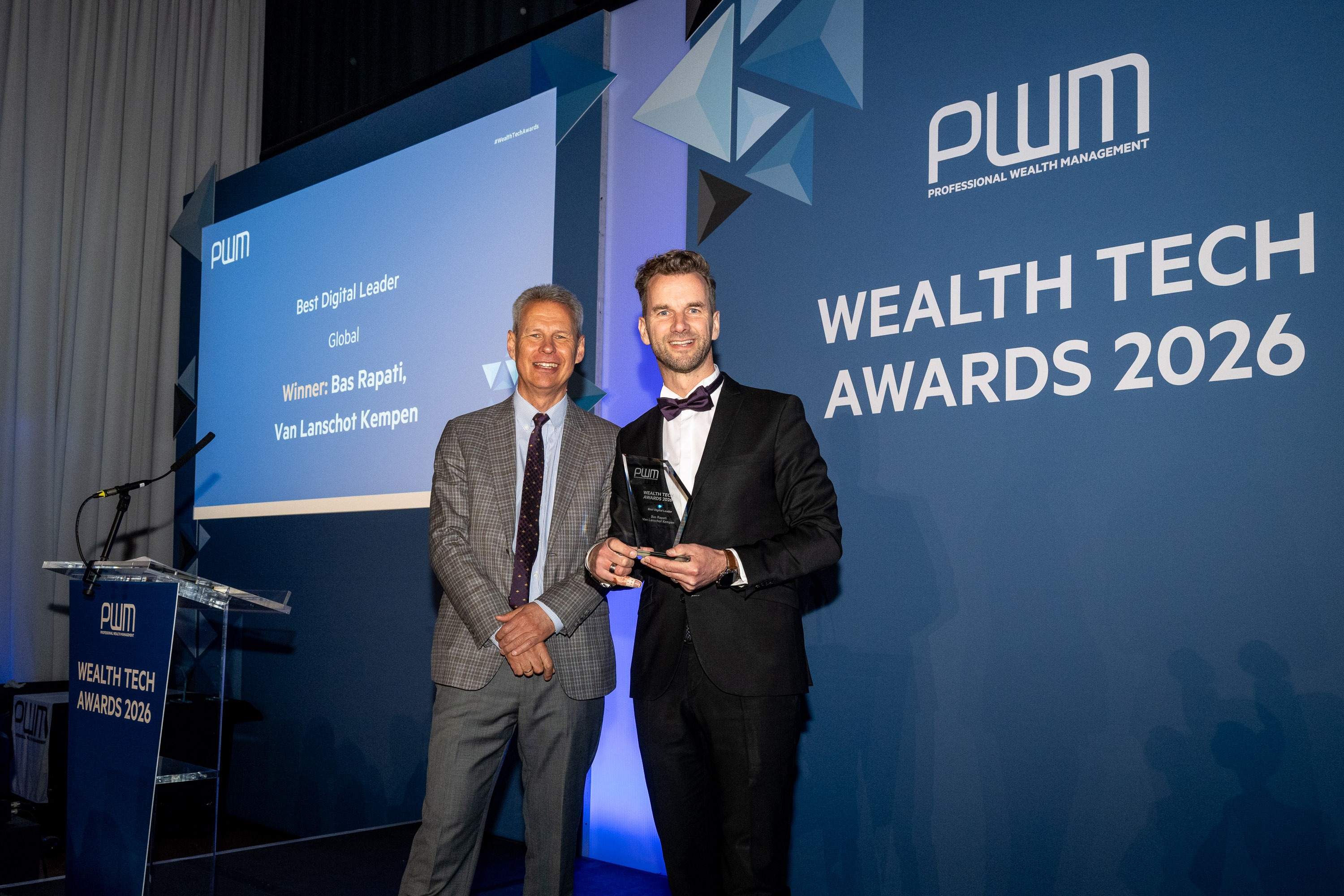
The approach has drawn recognition in this year’s PWM Wealth Tech Awards, where Rapati was named best digital leader. For the forward-looking and dynamic executive, however, recognition is collective.
“It’s not just a couple of people, this is for all of us,” he says, describing how successes are celebrated across teams.
Rapati’s interest in digital innovation dates back to the start of his career. Trained as a software engineer, he began working during the dotcom era.
“I always jokingly say that, when I was already studying, if you could touch a keyboard, businesses would welcome you in there,” he says.
During 15 years as a freelance consultant across public and private sectors, he identified a “sweet spot” between technology and business.
Wealth Tech Awards 2026
“I’ve always been fascinated by how technology can really help people,” says Rapati, typically dressed in smart blazer and upmarket sports shoes. “It’s not about the tools themselves; it’s about people and making an impact.”
When Rapati began driving transformation at Van Lanschot Kempen in 2016, the bank was merging Van Lanschot and Kempen, still operating under separate labels and IT set-ups and lagging in its digital capabilities.
The initial challenge was organisational rather than technical. “We created the sense of urgency at board level to say we now need to step up, to remain in business but also to continue having an impact for our clients,” he says. “Digital transformation goes beyond platforms and apps. It’s about changing how a bank works.”
The change began on the business side, with teams working with commercial staff before scaling across the organisation.
Today, digital leaders sit within core decision-making, helping to break down silos between technology and the business.
Building tech muscle
One of the most visible outcomes has been the expansion of internal technology capabilities. From around 40 IT staff, with most work outsourced, the bank today employs close to 500, almost all working in-house.
“The biggest advantage of that is that you build that tech muscle inside the company rather than from the basement on the IT side,” he says. “Innovation does not sit in one department; it becomes a movement spread throughout the company.”
The bank’s technology function operates through 66 small, cross-functional teams. “You build it, you own it, you run it,” Rapati says. He oversees around 90 people across 15 of these teams, focused mainly on private banking in the Netherlands and Belgium.
Bas Rapati — career highlights
2016 — Present: Van Lanschot Kempen — Chief Analytics Officer / MD Digital Innovation & Analytics; Executive Director Digital & Innovation
2006 — Present: Jabula ICT- Freelance Interim & Program Manager (Owner)
2012 — 2016: Van Lanschot Manager Front Office & Online; Team Lead (Data Warehouse; Project & Demand)
2004 — 2010: COA — Project Manager; Team Lead Application Management; Application Manager
That ownership encourages teams to design scalable, low-maintenance systems, freeing time for further innovation.
The model increases speed and alignment with clients, while reducing reliance on external advisers. “We couldn’t have gotten this far doing this with external consultants,” he says.
The bank favours rapid experimentation through proof-of-concept cycles, testing ideas in controlled environments and discarding those that do not deliver value. “We tend to do a quick proof of concept and, if needed, easily scrap it,” Rapati says.
This discipline extends to costs. Despite employing around 500 technology staff, out of 2,200 employees, he argues the more relevant comparison is with external vendor costs.
It also supports a broader goal: scaling the business without increasing headcount. The bank targets around 10 per cent annual growth in assets under management without matching increases in staff. “We really want to keep the same cost level,” he says.
At the same time, Rapati emphasises the need to remain outward-looking. “The last thing we want to do is stare at our navel and think we’re the best in the world,” he says.
To avoid this, the Dutch bank actively encourages teams to engage with peers, attend conferences and continuously benchmark themselves against the market.
Among the initiatives he highlights is ClientCenter, the bank’s core platform. Developed in-house and used daily by relationship managers, it consolidates client data, communication and workflows, with an AI assistant supporting tasks such as meeting preparation, summarising interactions and suggesting follow-up actions.
Client feedback flows directly to product teams, with selected client groups testing new features before broader rollout.
Process automation is another key pillar, transforming key workflows. Client onboarding can now be completed in under 30 minutes, while client due diligence has shifted from periodic reviews to continuous, real-time monitoring.
At the core is a clear distinction between what the bank builds internally and what it sources externally. Core capabilities, particularly those central to the client experience, are developed in-house, while commoditised services are integrated from external providers, including fintech partners.
Culture as differentiator
While technology provides the tools, culture determines whether they are adopted and used effectively.
Rejecting the idea that the bank, founded in 1737, is inherently “traditional”, he says. “If we had not changed, we would simply not exist anymore.”
He describes change as part of the bank’s DNA, accelerated by digitalisation. Innovation runs across the organisation through initiatives such as hackathons, training and knowledge-sharing sessions.
Hackathons bring together business and technology teams, with around half of the ideas eventually making it into production.
The fact that we have diverse teams really helps us to get better outcomes
This culture extends to talent and diversity. To address the limited pipeline of female tech graduates, Rapati has driven targeted women-in-tech internship events, giving candidates early access to roles; at a recent event, every attendee applied.
Those who work for him display a fierce loyalty, admiring his strategy to employ a diverse staff.
“It’s not about lowering the bar, it’s really about widening the gate,” Rapati says.
Within his teams, this approach has contributed to a roughly equal gender split and a majority of women in leadership positions.
“The fact that we have diverse teams really helps us to get better outcomes,” he says, adding that diversity is also essential “to tackle biases in AI models”.
Democratising innovation
A defining feature of the bank’s approach is the democratisation of innovation, with employees encouraged to develop and share solutions.
Internal platforms allow staff to create AI tools and agents that can be reviewed, shared and scaled.
A dedicated AI adoption team supports uptake through practical training sessions where business users build solutions around real use cases.
Many of these are small, low-code applications, which, if successful, are integrated into core systems. Leonardo, the bank’s internal AI platform, includes a marketplace where colleagues can publish agents, with relationship managers “super proud” when others begin using them.
This bottom-up model accelerates innovation while driving engagement and ownership, says Rapati.
More broadly, he sees AI’s impact across three areas: efficiency gains through the automation of routine tasks, changes to roles and workflows, and longer-term shifts to the business model.
As clients increasingly arrive with AI-generated plans, relationship managers must adapt, he says. While AI will absorb administrative tasks, it will not differentiate banks. “It’s going to be like electricity. We’re all going to do it.” What matters is execution and culture, where “trust in execution is rare”.
In private banking, where trust and relationships remain central, he sees AI as an enabler rather than a replacement for human interaction.
“You don’t want to give your wealth to a bot; you want to talk to an actual human.”
Alongside its opportunities, rapid technological change introduces new risks. While privacy and cyber security remain critical concerns, Rapati highlights “stagnation risk”.
“The biggest risk is stagnation. You’re doing the things basically for yesterday’s market,” he says.
In many organisations, innovation stalls at the pilot stage, only becoming a problem as client expectations shift or competitors advance. The bank mitigates this with rapid experimentation and short development cycles to move ideas into production.
This is supported by strong data foundations. A central platform integrates multiple sources, enabling personalisation and AI-driven insights while maintaining data quality through automated controls.
Inclusive leadership
Rapati’s leadership philosophy centres on ownership, accountability and what he describes as “responsible courage”.
“I really treat outcomes as my job, not somebody else’s,” he says, stressing the need to push forward despite constraints and not let regulation become a barrier to progress.
He also focuses on impact rather than tools. “Be obsessed with clients and employees, translating technology into better conversations, not better tools,” he says.
By sharing his own mistakes, he encourages teams to experiment, learn and iterate, an approach he sees as essential in a rapidly evolving environment.
Looking ahead, he identifies AI and digital assets as key drivers of change, with technologies such as quantum computing likely to have longer-term implications, particularly for cyber security and data processing.
His vision is not of a fully automated bank, but of a more effective one, where technology enhances human capabilities. The transformation, he says, is as much organisational and cultural as it is digital, and still “a work in progress”.
Many of these themes resonate with industry observers. “Bas Rapati’s impact as a digital leader lies in his ability to bridge strategy, technology and culture,” says Sandra Daub, chief marketing officer and head of business development at Noumena Digital and a judge of the Wealth Tech Awards.
“He combines deep business expertise with curiosity and an open, inclusive leadership style, focusing consistently on how technology can deliver meaningful client value.”
Bas Rapati’s impact as a digital leader lies in his ability to bridge strategy, technology and culture
What sets him apart, she adds, is his ability to embed digital across the organisation, “challenging conventional thinking and fostering a culture of innovation that is both client-centric and execution-focused”.
Alois Pirker, founder and CEO of Pirker Partners and a judge, highlights the bank’s culture, noting he has been “very impressed by the innovation-oriented culture” at Van Lanschot Kempen.
“Speaking with his team at last year’s Wealth Tech Awards event, I could not help but notice the energy and outside-the-box thinking that seem to be a hallmark of the organisation.”
Bas Rapati was named ‘Best Digital Leader’ in PWM’s Wealth Tech Awards for 2026


